
Paper on Georgius Benignus Published in an International Volume
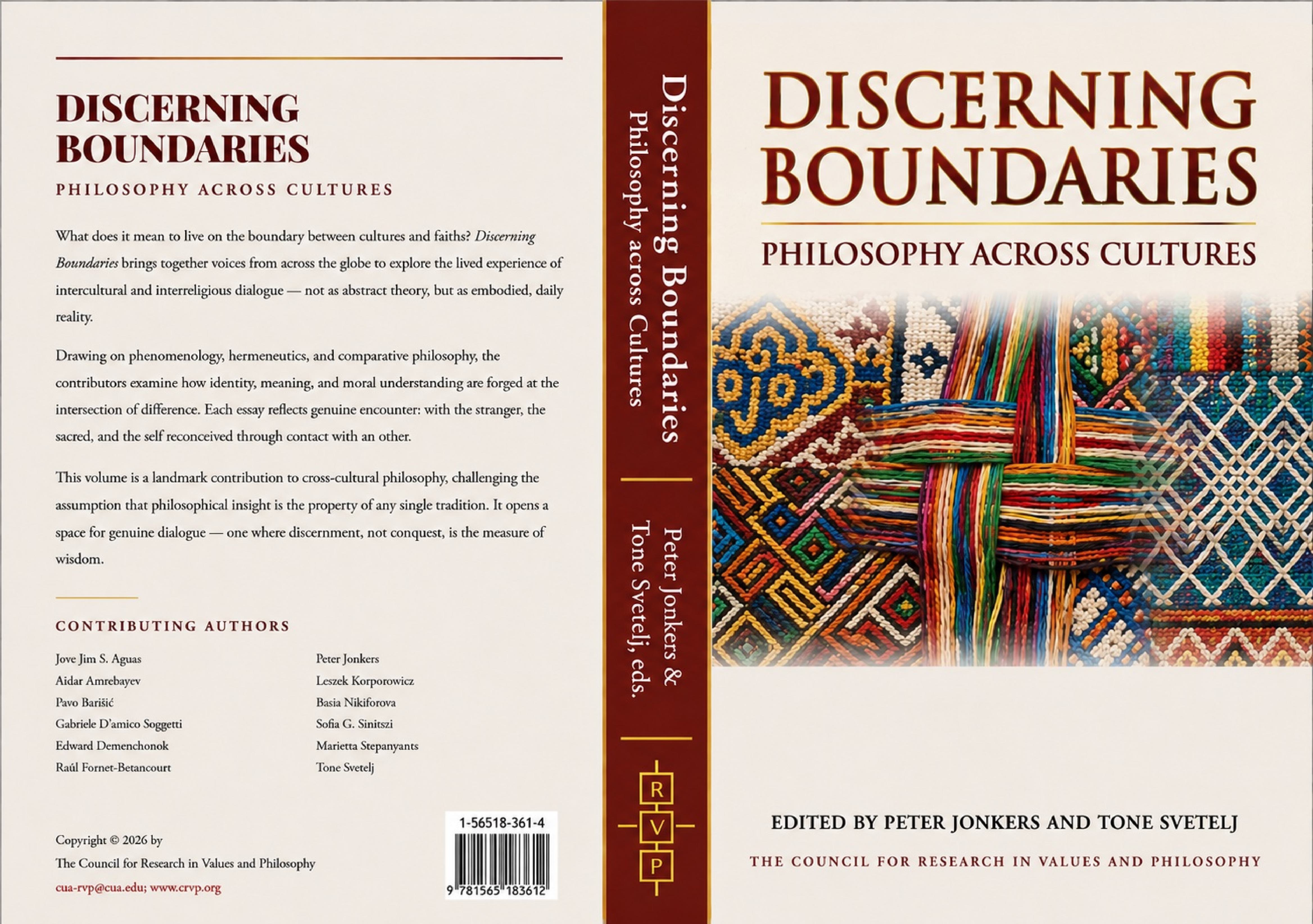
The Council for Research in Values and Philosophy (Washington, D.C.) has published the volume Discerning Boundaries: Philosophy across Cultures.
Among its twelve scholarly contributions is my paper, Philosophy across Boundaries in Defense of Human Dignity: Georgius Benignus’s Apologies of Bessarion, Mirandola, Savonarola, and Reuchlin.
The volume appears in the series Cultural Heritage and Contemporary Change and is edited by Peter Jonkers, Professor Emeritus of Philosophy at Tilburg University (the Netherlands), and Tone Svetelj, Professor of Philosophy and Theology at Hellenic College in Brookline, Massachusetts (USA).
According to the publisher, the volume brings together scholars from different parts of the world to reflect on the meaning of boundaries in both their philosophical and experiential dimensions. Particular attention is devoted to the question of how to discern those boundaries that foster human flourishing from those that divide and diminish human life, and to the ways in which philosophy, grounded in lived human experience and open to dialogue across disciplines and cultures, can contribute to understanding, critically examining, and reimagining them.
The contributions are based on papers presented at the international conference Understanding Boundaries: Philosophy across Cultures, held from 29 to 31 July 2024 at Villa Mirafiori, the home of the Department of Philosophy of Sapienza University of Rome. The conference, organised by the Council for Research in Values and Philosophy and the McLean Center for the Study of Culture at The Catholic University of America as a pre-conference to the XXV World Congress of Philosophy, brought together participants from many countries to reflect on the enduring relevance of philosophy and its transformative potential in an increasingly complex and fragmented world.
I presented my paper on the Croatian Renaissance philosopher and theologian Juraj Dragišić (Georgius Benignus) as a plenary lecture at the conference and substantially expanded and revised it for publication in the volume. In his introductory presentation, editor Tone Svetelj writes that the paper examines the philosophical and ethical reasons underlying Dragišić’s defence of four distinguished Renaissance thinkers—Basil Bessarion, Giovanni Pico della Mirandola, Girolamo Savonarola, and Johannes Reuchlin—each of whom faced condemnation and persecution in his own time.
Svetelj further summarises my portrayal of Juraj Dragišić as an advocate of intellectual freedom, human dignity, and interreligious dialogue, shaped by his humanist education in Italy and by the intellectual milieu of the Republic of Dubrovnik following his exile from Bosnia after the Ottoman conquest. Dragišić’s apologies, he observes, represent not merely a defence of individual figures but a broader vision of reconciliation, tolerance, and intercultural understanding grounded in Renaissance humanist ideals. In conclusion, he emphasises that the enduring significance of Dragišić’s thought lies in its belief in the universality of human dignity and in the power of philosophy to transcend boundaries—a message that continues to resonate in contemporary debates on freedom, pluralism, and intercultural dialogue.